Post-training
Reinforcement Learning for LLMs
Scale RL post-training from a single node to thousands of GPUs with Ray, the engine for veRL, skyRL and more.
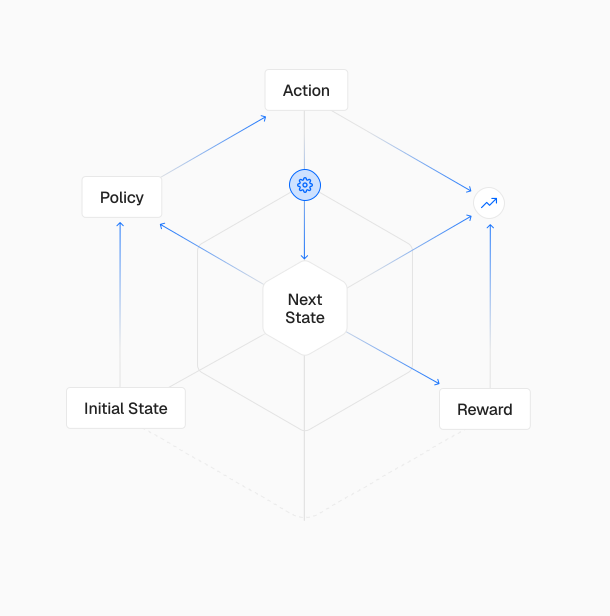
Scale RL with a unified engine for data, train and serve
Run the full post-training lifecycle on Ray, the world’s most widely adopted AI compute engine

End-to-end orchestration
Coordinate multiple frameworks running across CPU and GPU hardware with simple Python APIs.

Works with your RL library
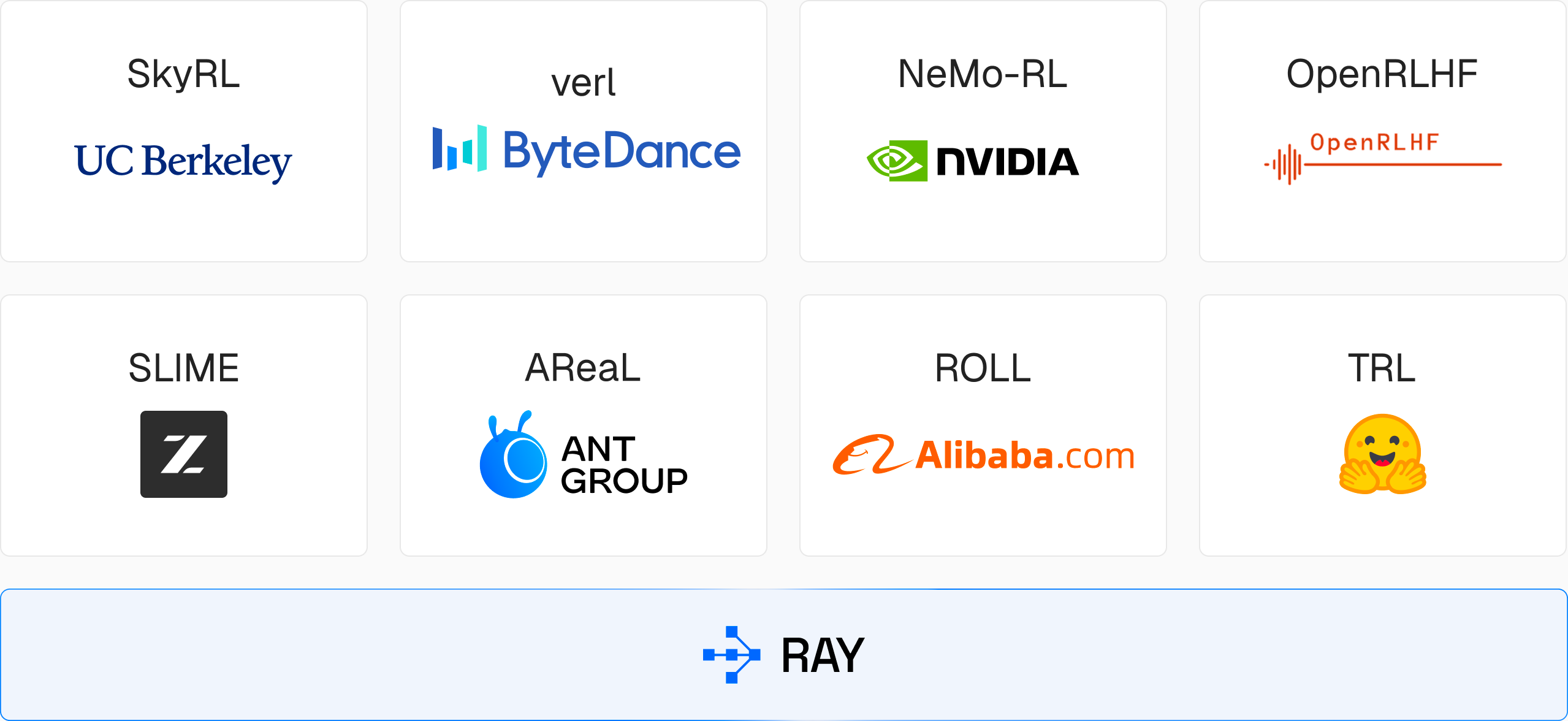
veRL, SkyRL, OpenRLHF, and other leading RL libraries are built on Ray, no rewiring required.

Native AI framework integration
Ray works seamlessly with vLLM, SGLang, and Megatron to keep rollout generation fast and GPUs utilized.
We built custom training infrastructure leveraging PyTorch and Ray to power asynchronous reinforcement learning at scale.”

We built custom training infrastructure leveraging PyTorch and Ray to power asynchronous reinforcement learning at scale.”
4x
Token generation efficiency for model trained compared to Frontier models
Unified compute for reinforcement learning at scale
Ray on Anyscale abstracts RL infrastructure complexity so you can focus on development
Multi-framework support
Run veRL, SkyRL, OpenRLHF, NeMo-RL, and other leading RL libraries across any cluster size.

Inference engine integrations
Native support for vLLM and SGLang — the inference engines that power modern RL rollout generation.

Rack-aware scheduling
Optimize placement of training and inference workers across complex hardware topologies (in preview).

Agentic & multi-turn RL
Coordinate multi-step environments, tool use, and reward computation across complex agent trajectories.

One runtime for all stages
Eliminate fragmented tooling with data prep, fine-tuning, RL, and online inference on a single runtime.

Advanced observability
Profile CPU/GPU performance in distributed data, train or serve runs with persistent logs and dashboards.
Build. Run. Scale. Repeat.
Deploy advanced AI applications without growing operational complexity with Ray on Anyscale.
Explore more on Anyscale
Multimodal data pipelines
Transform complex data modalities such as video, images, voice, text, and more into AI-ready datasets

Distributed training, fine-tuning
Scale existing training code from one machine to thousands of GPUs with intuitive scaling configs

Composite AI serving
Serve one or many models and Python applications working together as a single API endpoint